|
Improving one's spiritual life is a deeply personal and transformative journey that can lead to profound inner peace and fulfillment. Spirituality can provide a sense of purpose, connectedness, and a framework for understanding life's challenges. It goes beyond religious practices, encompassing a broad spectrum of beliefs and experiences that resonate with an individual's inner self. Whether through meditation, prayer, spending time in nature, or engaging in creative activities, nurturing your spiritual life can significantly enhance your overall well-being.
One of the key benefits of a robust spiritual life is its positive impact on mental health. Spiritual practices often promote mindfulness, gratitude, and a sense of connection to something greater than oneself. These elements can reduce stress, alleviate anxiety, and improve emotional regulation. Engaging in spiritual practices can create moments of stillness and reflection, allowing you to step back from the hustle and bustle of daily life and gain a clearer perspective on your thoughts and feelings. This introspection can lead to greater self-awareness and emotional resilience. Healing the nervous system is an essential aspect of improving one's spiritual life. Chronic stress and trauma can cause dysregulation in the nervous system, leading to symptoms like anxiety, insomnia, and physical tension. Spiritual practices such as meditation, deep breathing, and prayer can activate the parasympathetic nervous system, promoting relaxation and healing. These practices help to calm the mind and body, reduce the production of stress hormones, and enhance the body's natural ability to recover from stress. By integrating nervous system healing into your spiritual practices, you can create a harmonious balance between mind, body, and spirit. Another vital component of spiritual growth is fostering a sense of community and connectedness. Engaging with like-minded individuals who share your spiritual interests can provide support, encouragement, and a sense of belonging. This can be achieved through participating in group meditations, spiritual retreats, or discussion groups. Sharing your experiences and learning from others can deepen your understanding and commitment to your spiritual path. These connections not only enrich your spiritual life but also offer a network of support that can be invaluable during challenging times. Ultimately, improving your spiritual life is about finding practices and beliefs that resonate with you and integrating them into your daily routine. It requires patience, openness, and a willingness to explore and grow. Whether you are just beginning your spiritual journey or seeking to deepen your existing practices, the path to spiritual fulfillment is a continuous process of self-discovery and healing. By embracing this journey with compassion and hope, you can cultivate a spiritual life that brings you peace, joy, and a profound sense of purpose.
0 Comments
The mental health needs of LGBTQ+ individuals are unique and complex, often shaped by the distinct challenges they face in society. Discrimination, stigma, and the pressure to conform to heteronormative and cisnormative expectations can create an environment where LGBTQ+ people are more susceptible to mental health issues. Studies show that LGBTQ+ individuals are at a higher risk for depression, anxiety, and suicidal ideation compared to their heterosexual and cisgender counterparts. These elevated risks underscore the importance of providing tailored and sensitive mental health support that acknowledges and addresses these specific challenges.
One critical aspect of supporting LGBTQ+ mental health is understanding the impact of minority stress. Minority stress refers to the chronic stress experienced by individuals from stigmatized minority groups. For LGBTQ+ individuals, this stress can stem from various sources, including internalized homophobia or transphobia, experiences of discrimination, and social rejection. Such stressors can profoundly affect mental health, leading to feelings of isolation, low self-esteem, and chronic anxiety. Mental health professionals need to be aware of these factors and incorporate them into their therapeutic approaches, creating a safe and affirming space for LGBTQ+ clients. Healing the nervous system is a vital component of mental health care for LGBTQ+ individuals. Chronic stress and trauma can dysregulate the nervous system, leading to symptoms such as hypervigilance, anxiety, and emotional numbness. Techniques that promote nervous system healing, such as mindfulness, deep breathing exercises, and somatic therapies, can be particularly beneficial. These practices help individuals reconnect with their bodies, release stored tension, and cultivate a sense of safety and calm. By integrating nervous system healing into mental health care, therapists can help LGBTQ+ clients build resilience and recover from the impacts of trauma. Moreover, social support plays a crucial role in the mental well-being of LGBTQ+ individuals. Building and maintaining connections with affirming and supportive communities can mitigate the negative effects of minority stress. LGBTQ+ support groups, community organizations, and online forums can provide safe spaces for individuals to share their experiences, receive validation, and find solidarity. These connections not only reduce feelings of isolation but also empower individuals to embrace their identities with pride and confidence. Encouraging LGBTQ+ individuals to seek out and engage with supportive communities can significantly enhance their mental health and overall well-being. Ultimately, a compassionate and holistic approach to mental health care is essential for LGBTQ+ individuals. By addressing the unique challenges they face, promoting nervous system healing, and fostering supportive social connections, we can create an environment where LGBTQ+ individuals can thrive. Mental health professionals, allies, and communities all play a crucial role in this process. Through understanding, empathy, and proactive support, we can help ensure that every LGBTQ+ person has the opportunity to live a fulfilling and mentally healthy life. Now we will count to twelve and we will all keep still...What I want should not be confused with total inactivity. Life is what it is about...If we were not so single-minded about keeping our lives moving, and for once could do nothing, perhaps a huge silence might interrupt this sadness of never understanding ourselves. -Pablo Neruda, Keeping Quiet
Last week, I was doing an exercise class that focused on the legs. We did one side, and by the time we switched to the opposite leg, my whole lower body felt sore! I didn't want to move to the right side of my body, as the left side already hurt enough. I considered giving up, when the instructor spoke up. "Instead of focusing on the pain you are currently in and what you have left," she said, "appreciate the work you have already done." In that moment, my perspective totally changed. Instead of dreading the work left to be done, I started appreciating the other side of my body. I may have even congratulated myself out loud. As I thought about the work my body had done physically, I found myself lost in a series of personal memories where I had become overwhelmed by the tasks ahead of me. How many times had I spent more time dreading an exam in college than actually studying for it? Or what about the times when I have known I needed counseling but refused to go out of fear of the work ahead. The dread and anxiety about the future can seem crippling and even lead to a type of paralysis. But What If We Slowed Things Down? Instead of ruminating about our own fear and discomfort surrounding the future, what might happen if we paused to celebrate the small decisions that helped us arrive at our present. Is there something in your near future that surrounds you with anxiety? Maybe it's a job you are nervous to apply for, or a conversation with a friend that you are dreading. Or perhaps it is the day-to-day that bogs you down. When my child was younger, I used to lie in bed and think, "there is no way I will have enough energy to make it through tomorrow." What if we slowed down our worry and replaced it with remembrance? What made you interested in the job you are nervous to apply for? What professional skills are you proud of? What work did you do to attain those skills? Take time to remember what you have done and celebrate your accomplishments. For the mother worried that she will never have enough energy for the next day, remember the work you did that morning! Did you wake up? did you change diapers? did you hold and nourish your child? celebrate the work you have already done. As we take time to celebrate our past accomplishments, we can be led to empowerment and find freedom from anxiety. Can you pause today to celebrate the small victories in your life? What have you done today that has led you to success? What about in the past week or month? At times, our minds are moving so quickly that it seems impossible to slow down to pause and remember. If this practice seems too daunting to you right now, it could be helpful to seek outside help from a counselor. Working with a counselor will not only help you to create more space to make decisions, but will also help reduce overall stress. If you can in this moment, I invite you to pause. Appreciate the work you have already done. Losing loved ones is an inevitable part of living as a human. The times surrounding a loved one’s death can be the most challenging seasons in our lives. Even though loss is a universal human experience, people who are grieving often feel alone and isolated because it seems like no one understands what they are going through. Having a supportive community can provide comfort, solace and opportunities for healing. Finding a grief-oriented community can maximize healing opportunities. Grieving and healing in community is an ancient practice.Grieving and healing in community is an ancient practice. Before the rise of individual achievement focused societal structures, there were community gathering places and multigenerational homes where people knew how to hold other’s grief. Grief begins healing when it is externalized. We call this expression of grief mourning. We also know that healing happens when our suffering is witnessed and received by a compassionate party. Perhaps more than any other condition, a community of compassionate and understanding witnesses can unlock the power of healing for those who are grieving. We believe that healing in community happens by both hearing and being heard.We believe that community offers opportunities to heal by both hearing and being heard. When we resonate with the stories others are telling, we learn that we are not alone. Sometimes community members verbalize a part of our own experience we haven’t been able to speak about yet. When we are able to see ourselves in another’s story, we are bolstered by the togetherness we find in our common experiences. We also heal when we are able to share our own story in the safety of a group who will hold our experiences with tender compassion. We believe in the power of story-telling; that when we speak of our internal experiences, we are empowered to metabolize and release the pain. And when our sharing is witnessed in a caring and understanding way, we are more able to accept our painful circumstances. When the bereaved are able to give and receive in these ways, the strength of the group can carry all forward in healing. We invite all those who are navigating the grief related to the loss of a loved one to join our next Understanding Your Grief Support Group. More information can be found HERE. 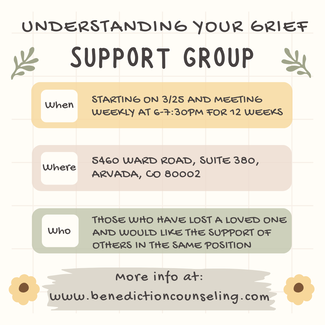 Written by Allison Harvey
Trauma survivors have gone through something that challenged every part of them, most significantly their sense of safety. Their needs are personal, unique to their personality and circumstances, and often quite delicate. Naming these needs creates space for trauma survivors to feel safe, work toward healing and maintain connection with loved ones. Physical Needs On a very basic level, trauma survivors have a need for safety and security. Through their traumatic incident(s), they learned to be on guard and watchful. Trauma survivors need a physical location where they can let their guard down and rest. Trauma survivors also need access to medical and psychological care—professionals to come alongside them and nurture their physical and emotional self back to health. Trauma survivors also need adequate nutrition and sleep. Tending to these basic needs helps to heal a nervous system that felt a strong lack of safety. Emotional Needs Those who have survived trauma(s) have a strong need for emotional understanding, empathy and validation. When they are ready to share about their story, they need to be received with compassion, support and validation that says “what you are feeling makes sense to me.” Trauma survivors can also be supported with emotional skills that help them navigate trauma triggers and a large emotional burden while they are healing. Social Needs Trauma healing happens within a safe, understanding and supportive relationship(s). Those who have survived trauma need their people to remain open to them. Trauma healing can be messy and indirect, so survivors need compassion and grace to learn to feel safe in relationships again. Survivors may need more accommodations so that they can stay regulated, and this may look like them setting boundaries or asking for certain changes. Connecting with others who are healing from trauma can be very beneficial as well. Psychological Needs Professionals who are supporting trauma survivors should be trauma-informed and have a path toward healing in mind. Psychological care should be gentle and paced by the survivor. Professionals should respect the trauma survivor’s wishes to tell their story or not, knowing that healing can happen either way. Trauma survivors benefit greatly from learning and practicing coping mechanisms and stress management techniques. All of these activities support the survivor to rebuild trust, regain resilience and personal strength. Written by Christian Swan on March 16, 2017
I still remember my exact location and can nearly return to the sensations I felt in my body the moment I got the text message. I remember reading the words, "active shooter," from my husband who was in his office on that sunny day in June. While my husband returned home safely that evening, there is no arguing that he suffered a major traumatic incident. In the days and weeks that followed, my husband and I received an overwhelming amount of support. Our phones were overloaded with text messages and calls from loved ones, and we even received a few free meals. I was very thankful for the community we had at the time, and yet noticed a common thread in all of the support we were receiving. "How is your husband? Is he doing better?" people would ask me. I would answer their questions, and they felt relieved to hear that my husband was healing well. However, I was still suffering, and I struggled to advocate for the support I needed at the time. As the loved one of a survivor of trauma, I also became a survivor of secondary/vicarious trauma. Secondary trauma occurs as a result of secondary exposure to traumatic content. When our loved ones are impacted by trauma, we want to listen to their story and help in any way possible. And yet, it is too easily to overlook the effects their stories have on our own bodies. These effects can manifest themselves in various ways, from sleep disturbance to irritability to excessive fear and worry. Do you have a loved one who recently survived a traumatic event? Perhaps you are feeling overwhelmed and excessively tired as you seek to provide care. You may also find yourself struggling to find meaningful ways to support your loved one. Below are some ways that you can support yourself during this time: 1.) Honor your experience as a secondary survivor of trauma. Often, secondary survivors feel guilty when they become overwhelmed by their loved one's story. It is too easy to say, "I need to stop feeling badly because the trauma didn't happen directly to me." Instead, consider the effects that these stories are having on your body and take time to name your own traumatic experiencing. 2.) Seek activities that nourish you. Some ideas may be getting outside, practicing yoga or meditation, going to a concert, calling a close friend, or taking a nap. What activities help you feel refreshed? Pursue them. 3.) Consider professional counseling. Taking time to focus on your own experience will not only help you to heal but will also give you more freedom to care for your loved one. "Traumatic events are extraordinary, not because they occur rarely, but rather because they overwhelm the ordinary human adaptations to life."
- Judith Herman, Trauma and Recovery When you hear the word, "trauma," what comes to mind? Growing up, I placed trauma in a category of things I only heard about on the news. Events like plane crashes, robbery at gunpoint, or natural disasters made sense to me. Of course they were big and terrible and traumatic--the news said so! However, as I got older, I realized that there was much more grey area about what was actually considered trauma or not. Some trauma is publicized, but other times thoughts about it can become so difficult that even one's closest friends do not know about it. Furthermore, trauma to one person may not be considered trauma to another. In these cases, is it still considered trauma? While some trauma can take a very clear and pervasive form, like in the cases I mentioned above, it can also be more subtle and even happen over a period of time. Often, individuals do not seek out the counseling treatment they need because they do not feel like their experiences were "bad enough." If you are wondering if you have experienced trauma and should consider counseling, I recommend asking yourself two questions. First, do you have experiences in your life that you would define as traumatic? I'm not asking whether your aunt or the newspaper or your Facebook feed calls it traumatic. Instead, I want to know how YOU feel about your experiences. If you have experienced an event in your life that you define as traumatic and want to talk about it, I would urge you to consider calling a counselor. You may be surprised by how healing it is to have your story of trauma validated by an objective individual. Perhaps you are certain you have experienced trauma, but still do not know if you should consider counseling. In that case, my second question to you is this: are you having difficulties in life that you did not have before the trauma occurred? For example, you may find that you struggle to sleep through the night, have an increased/decreased appetite, or have difficulty completing tasks efficiently at work or school. Or maybe the experience of the trauma has become so pervasive that you can't seem to stop thinking about it. By seeing a counselor, you can begin to develop coping skills that will reduce your post-traumatic symptoms and help you feel more functional in your daily life. If you can answer yes to one or both of these questions, it may be time to consider reaching out for trauma therapy. Healing is possible when you are willing to commit the time to properly honor your story in the context of a safe relationship. Written by Christian Swan on March 09, 2017  Practicing this DBT Skill can help us stay grounded and connected this holiday season! Mindfulness is a skill that, when practiced regularly, is a great tool to reduce stress, connect with our personal goals and create genuine connection with others. The holidays can be rich in memory, sentiment and relationship. They can also be full of family expectations, grief and reminders of trauma. These, and many more experiences, can overwhelm, cause us to disregard our own needs, and flood us with many different emotions. In order to enjoy the positive aspects of the holiday and skillfully navigate the challenges, try practicing mindfulness throughout your holiday season!
Mindfulness has three components:
Mindfulness as Stress-Reduction For many, the holiday season means a busy schedule and many more tasks and to-dos than normal. Practicing mindfulness in the midst of the whirlwind helps to produce moments of calm to catch our breath and remember our priorities. Mindfulness also helps us evaluate where our time and energy are going and make the most intentional decisions for ourselves in this season. Mindfulness as Social Support Paying attention to the present moment, without judgement can give us a lot of important information about what is happening in a room, or in a conversation. In the midst of a holiday gathering, take a moment to simply observe what is happening inside and outside of yourself. Allow yourself the gift of a few deeper breaths. Notice who is talking with who, and what those dynamics are like. Notice what is happening inside yourself as you connect with different people. Hold this information lightly and without judgement, and allow this information to guide your interactions. Mindfulness to support Intentional Decisions If you find yourself navigating a lot of spoken and/or unspoken expectations over the holidays, mindfulness skills can help you identify your needs and desires and to stay connected to them throughout the season. Spend some intentional moments noticing where you would like your time and energy to go this season, what would make it memorable and special for you and yours. Notice how other’s expectations are making you feel, especially if those expectations cause you to disregard your own needs and desires. Give yourself the gift of staying connected to yourself and your values, which becomes a much more congruent and grounded holiday experience. Living with depression can be a completely consuming experience. Those experiencing depression can have symptoms like persistent sadness, hopelessness, lethargy, low self-esteem, guilt, worthlessness, and more. These symptoms exist on a spectrum from mild to severe and short to long-term. Living day to day with depression feels heavy, aimless and dark. Often people suffering from depression are told to change their mindset in order to recover. We know that change must come from a much deeper place. In fact, living day to day with depression requires enormous amounts of courage and perseverance, and it helps those who are suffering to have this acknowledged and validated. Depression has several different causes and sources. There are strong inherited patterns for major depression. There are also significant hormonal impacts, especially in post-partum depression and pre-menstrual depressive disorder. Personality also has a strong influence on mood and energy and motivation. All of these different also create causes can also produce a predisposed sensitivity to depression. This blog post is to highlight when life circumstances or traumas are the source of depression. When this is the case, it is the nervous system that is leading the body and mind toward depression. And as such, treatment will need to be focused on healing the nervous system and helping the client work toward a different nervous system state. When the nervous system (read: trauma, overwhelm, life circumstances) is causing depression, healing must happen deeply in the autonomic (involuntary) nervous system. To understand the nervous system impact and the healing of nerves, we need to understand the Window of Tolerance. When we are in the window of tolerance, we are grounded, flexible and able to roll with the ups and downs of life. When we have a good amount of resilience, our window of tolerance is large and we are able to handle significant challenges without becoming too dysregulated. When we are under a lot of stress, our window of tolerance shrinks and we start to experience hyper or hypo arousal. Let’s discuss these nervous system states that exist outside of the window of tolerance. 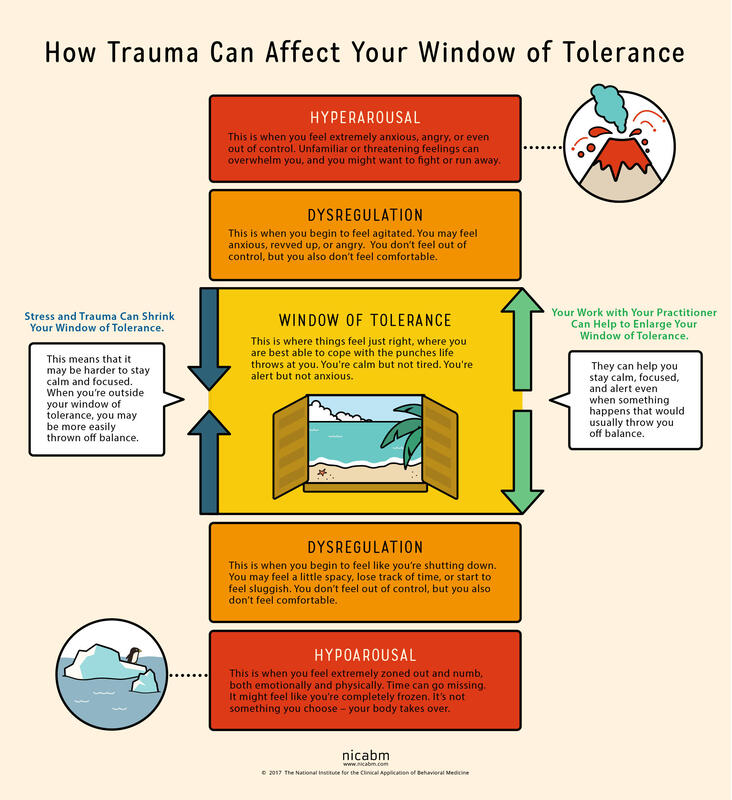 When we experience overwhelming stressors, we become dysregulated in one of two different directions, sometimes cycling between the two. We can become activated and have a flood of anxious or angry energy wash through our body (hyperaroused). Or we can become deactivated and experience numbness and a shut down response (hypoarousal). This hypoaroused state is the embodiment of depression. This is how stressors or traumas cause depression.
Hypoarousal symptoms also exist on a spectrum. On the milder side, we might experience tiredness, brain fog and a slump in energy. When hypoarousal is heightened, one might experience emotional numbness, dissociation, and even catatonia. Sometimes, we end up in this depressed state after an extended period of stress. It’s like our system is saying that it can’t handle that level of activation for that long and it shuts down. In other words, depression can be caused by a nervous system shut down. So, what does our nervous system need when it is in this shut down state? Sometimes, it simply needs a break. It needs rest from the hyper-activated state. The nerve that runs these activation pathways has become raw and overworked and needs to be soothed. The nervous system also has a significant need for connection when it is in this state of shut down. It needs a form of connection that is accepting, supportive and understanding. The nervous system also needs a way to process or integrate the overwhelming emotions that shut it down in the first place. This typically needs to happen at a slow and measured pace, so not to overwhelm again. These interventions serve as a ladder that helps us climb out of the shut down state, closer and closer to that window of tolerance. For a sustained healing process, we also need to take a good look at our lifestyle. When healing from a nervous system shut down, we need to choose a gentle pace of life, avoiding any additional stressors when possible. We can boost our nervous system health with meditation and mindfulness skills. We can invest in sustainable sleep habits that allow our entire system to regenerate every night. Gentle, joyful movement practices can also lift us out of shut down or depression. We at Benediction honor your nervous system and it’s inherent needs and functions, and we know how to move you out of harmful nervous system pathways. We can help you reconnect with yourself and with others by bringing your system back into balance in that lovely window of tolerance. |
Archives
July 2024
Categories
All
|
 RSS Feed